
By Maureen Achieng,
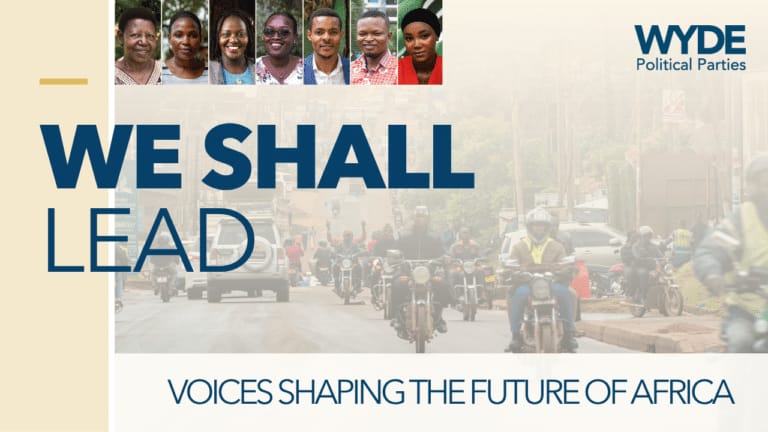
With the general election approaching, the European Network of Political Foundations (ENoP), in collaboration with Kanoni Media, convened the “We Shall Lead” forum at an hotel, Nairobi.
The event themed “Who Gets to Lead? Media, Citizens and the Future of Leadership in Kenya” focused on breaking barriers for women and youth in political leadership, alongside the role of the press in driving equitable governance.
Political aspirants at the forum shared their experiences navigating party structures, highlighting both progress and ongoing challenges regarding nominations and appointments.
Wandiru Gladys, a parliamentary candidate for the Kibera constituency under The Equitable Party a region traditionally dominated by male politicians recounted how her leadership journey began in her school years before transitioning into public service through youth leadership roles.
She noted that her selection as a parliamentary candidate stemmed from her consistent community advocacy. She further emphasized that her party prioritizes the inclusion of women and youth;
“What we are doing, the first declaration that we made was that the first appointment [the party leader] makes to the presidential secretariat will be a young woman. That is exactly what he did recently when appointing his communications team. As you may be aware, the team comprises women who are vocal on social media. Kwetu ni kusema na kutenda that was just the first step, and more is incoming.”
Isiah Kaaka, who is vying for the Kajiado West parliamentary seat, described the broad-based government structure as a platform for nurturing young talent;
“As part of the broad-based government, we are very objective about youth. We are nurturing young people and we are going to change the narrative.”
However, money politics and nomination irregularities remain significant hurdles for emerging leaders. Wanjiku Thiga, National Youth League Chairperson for the Democracy for Citizens Party (DCP), recalled losing a nomination ticket in 2022 due to financial influence;
“We have been keen on nominations because that is where the youth lose out which is also where I lost out in the 2022 polls. Back then, consensus consensus-building was used, and whoever topped three polls was awarded the ticket. The following day, I saw an older candidate given the ticket after money exchanged hands. When I lead DCP Youth, I lead from a place of empathy because I know how young people are taken advantage of. It has required constant engagement with my party leader to emphasize that we must honor our commitments and guarantee a free nomination process.”
Media professionals at the forum addressed how newsrooms handle political reporting, the responsibility of journalists, and structural challenges in reaching marginalized audiences.
Mary Wangari, a political reporter with Nation Media Group, stressed that professional ethics prohibit reporting stories that unfairly disparage opponents without substance. She urged female candidates to focus on policy agendas rather than personal attacks:
“You might speak and run in a viral clip, but for me as a political reporter to write a story, I need substance. Have you confronted a bill? Are you addressing maternal health such as women being locked out of hospitals? If you lack substance and use your platform only to fight fellow female aspirants rather than explaining what you will do differently, the story ends before it even starts. I cannot pitch it to my editor, and it will not run.”
Tom Japani, General Manager of Transworld Radio operating across North-Eastern and North-Western Kenya highlighted structural barriers to media access in pastoralist regions, where radio sets are predominantly controlled by men;
“Other than broadcasting, we conduct outreach programs engaging community leaders in behavioral change communication to push for culture change. We encourage aspiring youth and women to participate because transformation starts with engagement.”
Ela Obota, a Sub-Editor at Citizen Digital, discussed the tension between viral content and substantive journalism, while challenging ageist assumptions in Kenyan politics;
“As much as we want to give the audience viral content, we must filter it to see if there is substance and whether it adds value to the narrative. Regarding youth, there is a general notion that young people lack experience and cannot sit at the table with long-serving leaders. However, this narrative shifted following the June 25th ‘Gen Z’ protests, which demonstrated that young people know their rights and possess the capacity to drive change.”
Looking ahead to the 2027 General Election, panelist aspirants called for urgent reforms, including capping campaign financing costs, ending cash-drop politics, and eradicating political violence.
“First of all, politics should not be treated as a matter of life and death ni kufa kupona. We do not need to complicate things. The first thing we must change is to loosen up the political space and lighten the load.”
The event was organized with support from the Kenya International Center (KIC), Green Forum, KEPHRA, and the Konrad-Adenauer-Stiftung (KAS).